


If you sell through a marketplace or take orders in Instagram DMs, you already know the trade-off. The products are yours, but the storefront, the rules and the relationship with the buyer run through someone else's platform.
Shopify is the platform built for that move. It's a commerce platform for selling online and in person: your own branded storefront, a checkout, and one admin for orders, inventory, payments and marketing, with plans that run from solo sellers to large brands. This Shopify review covers what you actually get, the costs that sit beside the monthly fee, and who it fits. The honest catch: the subscription is only part of the bill, and several of Shopify's most useful tools depend on Shopify Payments, which isn't available in every country.
Shopify Review: Quick Verdict
Is Shopify worth it for a small business? Yes, if you sell physical or digital products and want your own branded store with checkout, payments, inventory and marketing in one admin. Every plan includes unlimited products, hosting and a custom domain. Skip it if Shopify Payments isn't available in your country and third-party transaction fees would eat into thin margins.
Best for: solo sellers and small teams moving off marketplaces or social DMs onto a store they control.
Skip if: you need extra staff logins on the entry plan, or you sell items Shopify's acceptable use policy prohibits.
Pros
- Your own branded store, with unlimited products, hosting, a custom domain and a free SSL certificate on every plan
- One admin for your website, social channels, Amazon and eBay listings, and in-person sales
- Email and SMS campaigns, discount codes and gift cards built in
- Sidekick, Shopify's AI assistant for writing product descriptions, included with plans
Cons
- A third-party transaction fee applies if you don't use Shopify Payments
- The Basic plan includes no additional staff accounts
- The free trial lasts 3 days, and you need a paid plan to start selling
Want to see the current plans and trial terms for your country? The card below takes you to Shopify through our affiliate link.

Shopify at a Glance
Everything in this table comes from Shopify's own pricing and product pages. Shopify's marketing figures are marked as its claims.
| Feature | Detail |
|---|---|
| What it is | A commerce platform for selling online and in person, with hosting included |
| Plans | Basic (solo entrepreneurs), Grow (small teams), Advanced (global reach), Plus (complex businesses) |
| Staff accounts | Basic: none additional; Grow: up to 5; Advanced: up to 15; Plus: unlimited |
| Inventory locations | 10 on Basic, Grow and Advanced; 200 on Plus |
| Included on every plan | Online store with themes, unlimited products, hosting, custom domain, free SSL, inventory management, 200+ real-time reports, email and SMS campaigns, discount codes, gift cards, Sidekick AI assistant |
| Sales channels | Online store; Facebook, Instagram, TikTok and YouTube; Amazon and eBay (plus Walmart and Target Plus in the US) through Marketplace Connect; Shopify POS; AI shopping tools such as ChatGPT and Google Gemini |
| Payments | Shopify Payments where available; third-party providers elsewhere, with an added transaction fee |
| Support | Live chat on Basic and Grow; enhanced live chat on Advanced; priority 24/7 phone support on Plus |
| What you can sell | Physical and digital products, memberships, subscriptions, ticketed experiences and consulting services, excluding prohibited items |
| Free trial | 3 days, no credit card required |
| Claims (per Shopify) | Used by millions of businesses in 175+ countries; 21,000+ apps in the Shopify App Store; checkout with Shop Pay converts up to 50% higher than guest checkout |
What Stands Out
You own the storefront, not a listing. Shopify's own FAQ draws the line clearly: Amazon is a marketplace where you list alongside other sellers, while Shopify lets you run your own branded store. You don't have to give up the marketplace, either. Shopify says you can keep selling on Amazon and manage those listings from your Shopify admin.
One admin for every place you sell. Orders and inventory from your online store, your social channels, marketplaces connected through Marketplace Connect, and in-person sales through Shopify POS all run through the same dashboard. POS is available on every plan, and customers can order online and pick up in person. Shopify has also added agentic storefronts that put your products in AI shopping tools such as ChatGPT and Google Gemini, although the ChatGPT channel requires selling to US customers.
The entry plan isn't stripped down. Every plan includes unlimited products, hosting, a custom domain with a free SSL certificate, inventory management, 200+ real-time reports, and marketing tools such as email and SMS campaigns, discount codes and gift cards. Sidekick, Shopify's AI assistant, helps write product descriptions and other content; it's included with plans, though its features and usage limits vary.
A checkout designed to convert. Shop Pay saves shoppers' details so returning customers check out faster, and Shopify says checkout with Shop Pay converts up to 50% higher than guest checkout. Treat that as Shopify's own figure rather than an independent test.
What to Know Before You Buy
The monthly fee isn't the whole bill. Shopify charges a subscription, bills payment processing separately, and adds a transaction fee when you use a third-party payment provider instead of Shopify Payments. Many specialized features come from the Shopify App Store, which Shopify says lists 21,000+ apps, so check whether what you need is built in or an app, and what that app charges, before you commit.
Shopify Payments isn't available everywhere. It's offered only in certain countries, and several features depend on it, including shipping labels and shipping insurance, built-in fraud analysis and some international selling tools. Confirm it's available where your business is based before you build around it.
The entry plan is built for one person. Basic includes no additional staff accounts and no third-party calculated shipping rates. If a partner or employee needs their own login, you're looking at Grow, with up to 5 staff accounts, or higher.
The trial is short. Shopify's free trial lasts 3 days with no credit card required, and you must choose a paid plan to start selling. Have your photos, descriptions and shipping details ready first.
Some features are limited by country or product. Shop Promise and the Shopify Fulfillment Network are limited to US businesses, text-message campaigns work only in supported countries, and certain products are prohibited under Shopify's acceptable use policy.
How to Get Started With Shopify
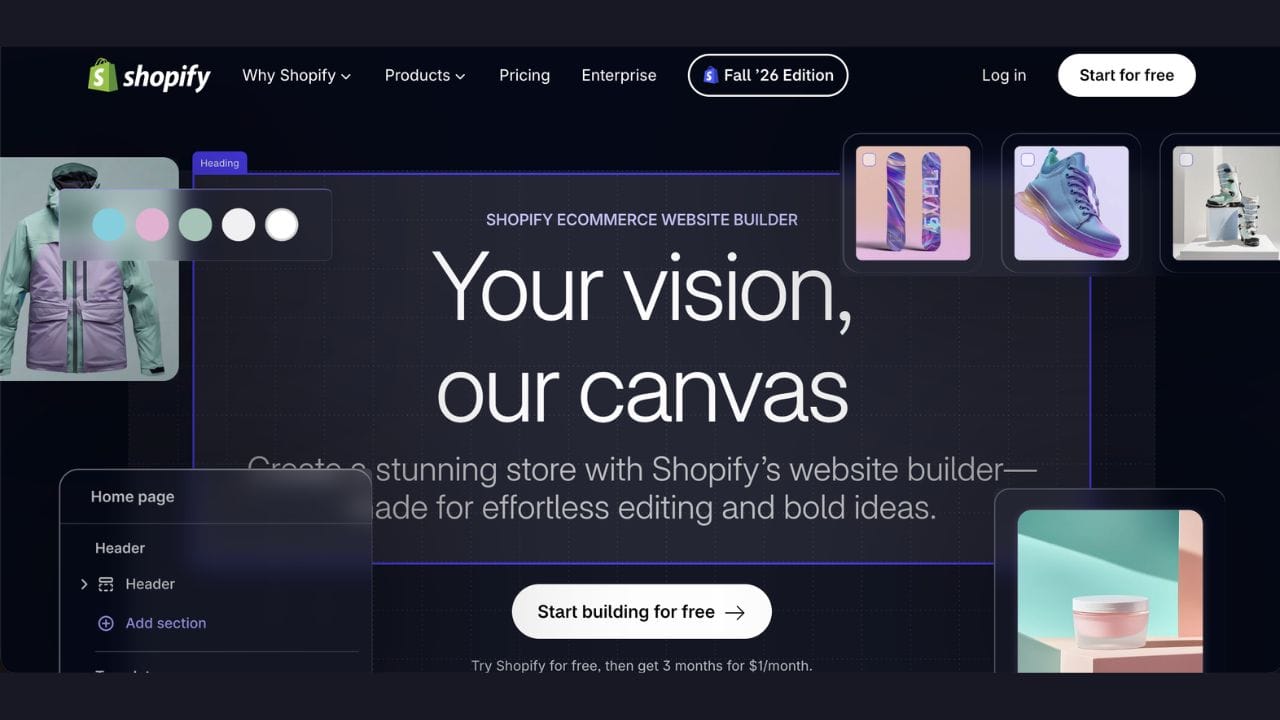
Shopify describes getting started in six steps:
- Start the free trial; no credit card is required.
- Design your store with a theme, or let Shopify's AI generate one from a description of your brand or products.
- Add your products. Every plan supports unlimited products, physical or digital.
- Set up payments with Shopify Payments where it's available, or a third-party provider where it isn't.
- Connect the channels you sell on: social platforms, marketplaces through Marketplace Connect, and Shopify POS for in-person sales.
- Choose a paid plan before you start selling.

What to Compare When Choosing an Ecommerce Platform
- Total cost per sale. Add the monthly fee, payment processing, any third-party transaction fee and the apps you'll need.
- Payment processing in your country. On Shopify, Shopify Payments availability decides whether you get several built-in features.
- Staff logins. Count who needs access; on Shopify, extra staff accounts start on Grow.
- Every channel you sell on. If you also sell in person or on Amazon, look for built-in point of sale and marketplace connections, as Shopify offers.
- What you sell. Check each platform's rules. Shopify supports physical and digital products, subscriptions, memberships, tickets and services, but prohibits some items.
Who Should Buy Shopify (and Who Shouldn't)
Shopify fits solo sellers and small teams who are ready to own their storefront instead of renting space on a marketplace, especially if you sell in more than one place: online, on social, on Amazon or eBay, and at markets or a shop counter. It also suits sellers who want marketing and analytics in the same admin as their orders.
Look elsewhere if Shopify Payments isn't available in your country and third-party fees would squeeze thin margins, if you need several staff logins but want to stay on the entry plan, or if what you sell falls under Shopify's prohibited items. If you sell only a handful of items now and then, a full store subscription may be more than you need.
Final Verdict
Our verdict: Shopify is worth it for small businesses that are ready to own their store. Even the entry plan includes the essentials, from unlimited products, hosting and a custom domain to inventory, reports and email and SMS marketing, and one admin covers your website, social channels, marketplaces and in-person sales as you grow.
The biggest trade-off is cost beyond the subscription: payment processing, a third-party transaction fee if you can't use Shopify Payments, and any apps you add. Price those out for your country and your product mix before you commit, and plan your setup around the 3-day trial.
If you sell through someone else's platform today and want a branded store you control, Shopify is our recommendation for that move. Start on the plan that matches your team size, and upgrade when you need more staff accounts or shipping options.
Ready to test it with your own products? The card below goes to Shopify; it's an affiliate link, so we may earn a commission at no extra cost to you.
Sell everywhere people shop. Online and in person. Across AI and on social. Locally and globally.
FAQ
Is Shopify worth it for a small business?
For most small sellers who want their own branded store, yes. Every plan includes unlimited products, hosting, a custom domain and marketing tools. Weigh the full cost first: subscription, payment processing and any apps you add.
Is Shopify good for beginners?
Shopify is set up so you don't need to code. Themes are customizable without coding, Shopify's AI can generate a theme from a description of your brand, and Sidekick helps write product descriptions. The Basic and Grow plans include live chat support.
Does Shopify charge transaction fees?
Shopify charges a monthly subscription and bills payment processing separately. If you use a third-party payment provider instead of Shopify Payments, Shopify adds a transaction fee on every plan. Current rates vary by plan and country and are listed on Shopify's pricing page.
Is Shopify like Amazon?
No. Amazon is a marketplace where you list alongside other sellers; Shopify lets you run your own branded store. You can do both: Shopify says you can manage your Amazon listings from your Shopify admin.
Does Shopify have a free trial?
Yes. Shopify offers a free 3-day trial with no credit card required. You need to choose a paid plan to start selling, so check the current trial and plan terms for your country when you sign up.
Can I use my own domain with Shopify?
Yes. You can use a domain you already own or buy a new one, and every store also gets a free myshopify.com address. Custom domains and a free SSL certificate are included on every plan.
How We Choose
Our editors research products using publicly available information, primarily the manufacturer's own product page and listed specifications. We weigh ingredients or features, clarity of labeling, overall value, and the reputation of the brand and seller. Unless we say otherwise, we have not personally tested this product, and we do not publish customer testimonials we cannot verify.
This product was independently selected by our editors. Good Guru Reviews may earn a commission from links on this page if you decide to buy something, at no additional cost to you. That is how we stay in business.
Disclaimer: The information presented, including general product details and any dietary supplement labeling or claims, is for reference only. Always consult original product labels, warnings, and professional advice before purchasing or using any product. If you have questions or wish to verify product information, contact the manufacturer using the details on the packaging.


